The NMJL 2026 Card
The National Mah Jongg League publishes a new card of official hands every year. NMJL 2026 Card mode builds the entire app around that specific card — hand matching, Live Co-Pilot suggestions, Table Scorer identification, and Score Sheet scoring are all driven by the actual 2026 line list, not a generic hand-building engine. This page covers what's different about it and how each tool uses it.
What's different about this mode
Every other ruleset in this app lets you build toward a hand shape freely, then scores whatever you end up with. NMJL 2026 Card mode works the opposite way around: your rack is matched directly against the official card's published line list, and only a hand that genuinely appears on the card — in the exact structure that line requires — counts as a legal target. This is why you'll see hands referred to by their card position, like 2026 #1 or Winds Dragons #2, rather than descriptive names the way Custom Hands mode uses them.
The American (NMJL) option described in Rulesets & Custom Hands is a separate, older ruleset. NMJL 2026 Card is its own dedicated mode, matched specifically and only against the current year's official card — select it directly from the ruleset dropdown in the top bar.
Selecting NMJL 2026 Card
Choose it from the ruleset dropdown
Open the ruleset selector in the top bar and choose NMJL 2026 Card. A second dropdown appears next to it, labeled NMJL 2026 Card, for picking a specific target hand — for example Winds Dragons #2.
Leave it on auto, or lock a target
Leave this on the app's own top recommendation to get suggestions across the whole card, or lock it onto one specific hand if you already know which line you're chasing. This mirrors how Target Strategy works in Custom Hands mode.
Watch the card-position counter
Next to the hand dropdown, a small counter (for example 0 / 55) tracks your position against the full set of hands on the card, so you always know how many lines you're working from.
Live Co-Pilot with NMJL 2026
Live Co-Pilot works the same turn-by-turn way described in its own guide page, with the recommendations themselves driven entirely by the 2026 card.
Top 3 Match Strategies
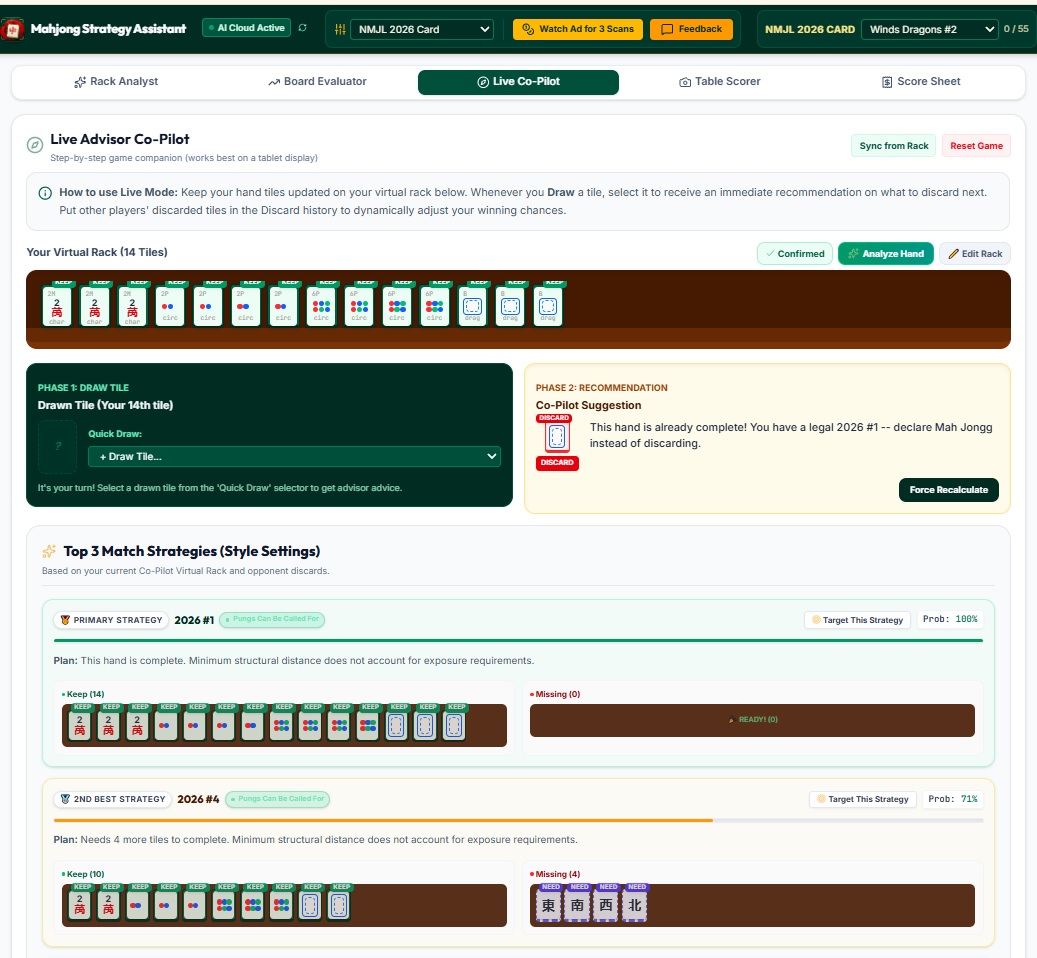
Instead of one single suggestion, Co-Pilot shows up to three candidate hands from the card at once — a Primary Strategy and up to two runners-up — each labeled with its card position (like 2026 #1) and a completion probability.
Keep and Missing, per strategy
Each candidate shows exactly which tiles in your rack count toward it (Keep) and exactly which tiles you still need (Missing) — so you can compare a hand that's nearly there against a riskier one with a better payout, before committing.
Target This Strategy
If one of the runner-up hands looks like the better bet, tap Target This Strategy to lock Co-Pilot onto it directly, the same as picking it from the top-bar dropdown.
Declare instead of discard
When a hand is already complete and legal, Co-Pilot's recommendation changes from a discard suggestion to telling you to declare Mah Jongg instead — it won't suggest breaking up a finished hand.
Force Recalculate
If your rack or the discard history changes in a way Co-Pilot hasn't picked up automatically, tap Force Recalculate to refresh all three strategies immediately.
Each strategy is tagged with whether that specific card line allows exposed melds — some 2026 hands must stay fully concealed until the winning tile, others allow pungs and kongs to be called from other players throughout. This badge reflects the card's own rule for that exact hand, not a general setting.
Table Scorer with NMJL 2026
The scoring-tool choice described in the Table Scorer guide — AI Camera Referee or Classical Manual Calculator — works the same way here. Inside AI Camera Referee, NMJL 2026 mode adds a third scanning option beyond the usual winner-only and whole-table scans:
| Mode | What it does |
|---|---|
| Quick Score | Photograph just the winning hand. For standard scoring this is all you need — opponents' concealed tiles have no effect on the score. |
| Full Table Scan | Photograph the whole table layout for interactive strategy coaching and layout auto-detection across all four players. |
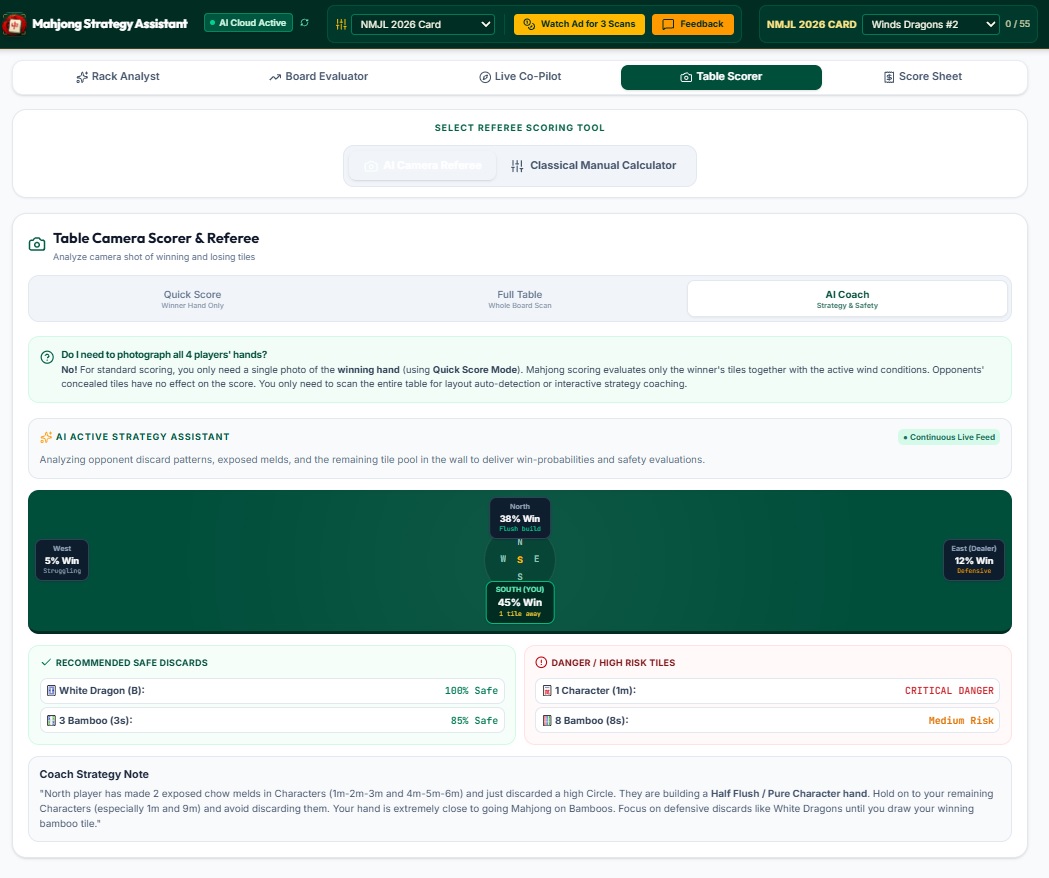
| AI Coach | A continuous live feed that reads opponent discard patterns, exposed melds, and the remaining tile pool to estimate every player's win probability and flag which of your own tiles are safe or dangerous to discard. |
Win-probability radar
Each of the four seats gets a live win-percentage estimate and a short read on their build — for example, a player closing in on a flush versus one who looks defensive or stuck.
Recommended Safe Discards
Tiles the app considers low-risk to throw away right now, each with a safety percentage.
Danger / High Risk Tiles
Tiles flagged as risky to discard, ranked from Medium Risk up to Critical Danger, based on what opponents appear to be building.
Coach Strategy Note
A short written explanation tying the numbers together — what an opponent's exposed melds suggest about their hand, and what that means for what you should hold onto or avoid discarding.
Win probabilities and danger ratings are estimates built from what's visible on the table — discards, exposed melds, and remaining wall count. They update as the game develops and are a strategic aid, not a certainty.
Score Sheet with NMJL 2026
Session tracking — player setup, running standings, dealer rotation — works exactly as described in the Score Sheet guide. NMJL 2026 hands add a few fields of their own to the Log Hand Manually panel:
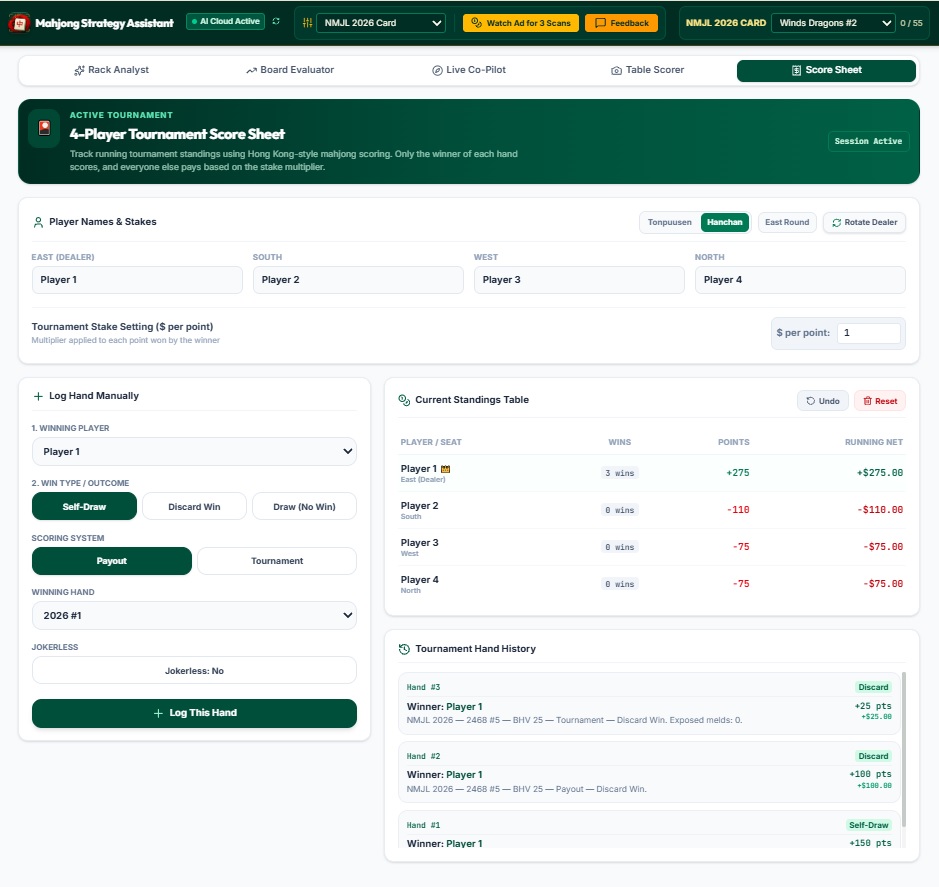
| Field | What it means |
|---|---|
| Scoring System | Choose Payout or Tournament — see below, since these calculate winnings differently. |
| Winning Hand | Pick the exact card line that won, by its card position (for example 2026 #1) — this determines the hand's base value. |
| Jokerless | Mark whether the winning hand used no Jokers at all. Jokerless hands are worth more on hands where the card allows it; this toggle only appears for hands where it actually applies. |
Payout scoring pays and charges every player directly based on the winning hand's value and how it was won — a self-draw costs every opponent more than a discard win costs the single discarder. Tournament scoring instead awards the winner a fixed point value for that hand, with a smaller, separate deduction from the discarder on a discard win — built for session formats that track cumulative tournament points rather than head-to-head payouts.
Once logged, the hand appears immediately in Tournament Hand History with its card line, base hand value, scoring system, and win type, and the Current Standings table updates with the new running totals for every player.